
Description
What is the Quality Circle Process Poster?
The above image is only a preview of the poster.
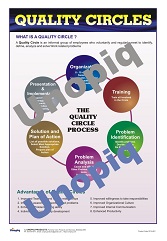
This Quality Circle Process Poster explains how teams solve work problems together.
It shows a clear cycle used in quality circles inside organizations.
Therefore, it helps people remember the flow during meetings.
Moreover, it visually links the steps to improvement results.
Key ideas shown on the poster include.
First, teams organize a small circle with a clear leader.
Next, members learn basic problem-solving tools and meeting rules.
Then, the circle selects a real workplace problem to study.
After that, members collect facts, data, and observations.
Consequently, the team analyses causes and identifies root issues.
Later, the team prepares solutions and an action plan.
Finally, the team presents results and follows up on actions.
Who can use this poster?
This poster fits any workplace that wants structured improvement.
Also, it supports both shop-floor teams and office teams.
Because the steps are universal, many functions can use it.
Common users include.
Production and maintenance teams running daily improvement.
Quality, QA, and QC teams supporting problem resolution.
Lean, Kaizen, and Operational Excellence coordinators.
HR and trainers delivering quality circle awareness sessions.
Supervisors and line leaders guiding small group meetings.
Service teams improving turnaround time and customer experience.
ISO 9001 teams strengthening participation and corrective actions.
Project teams reducing rework, delays, and repeated defects.
You can place it near meeting rooms or notice boards.
So, teams see it before and during discussions.
Also, you can use it during toolbox talks and training huddles.
Why is it useful for continuous improvement?
Quality circles work best with a repeatable method.
Therefore, this poster creates a shared language for the team.
Moreover, it reduces confusion during the first few meetings.
Additionally, it reminds members to use facts, not opinions.
Use it to support practical actions.
First, set a regular meeting cadence and a simple agenda.
Next, define the problem in one clear sentence.
Then, record data points, not only impressions.
Afterward, explore causes using tools like 5 Whys.
Also, validate causes with evidence from the process.
Consequently, choose solutions that remove causes, not symptoms.
Meanwhile, assign owners, dates, and checks for each action.
Finally, review results and standardize the improved method.
Typical problems quality circles can tackle include.
Frequent rework, scrap, and customer complaints.
Machine stoppages, tool damage, and minor accidents.
Dispatch delays, documentation errors, and billing mismatches.
High waiting time, motion waste, and material mix-ups.
Poor housekeeping, unclear labels, and recurring audit findings.
Advantages become visible when teams follow the cycle. For example, teams reduce variation and stabilize outputs.
Similarly, teams improve communication across shifts and roles. As a result, managers spend less time on repeat firefighting.
Consequently, employees feel ownership and suggest better ideas. Finally, the organization builds a culture of prevention.
It also helps training and onboarding.
New members learn faster with a visual reference.
Similarly, leaders can coach without lengthy explanations.
As a result, teams build confidence and ownership.
Also, the poster supports quick refreshers before audits.
Specifications:
Size: 13″ x 19″.
Finish: Soft laminated.
Material: 300 GSM board.
Note: This poster supports learning and awareness. However, you must apply your own procedures and controls. Also, Unopiq Products is not responsible for process outcomes.